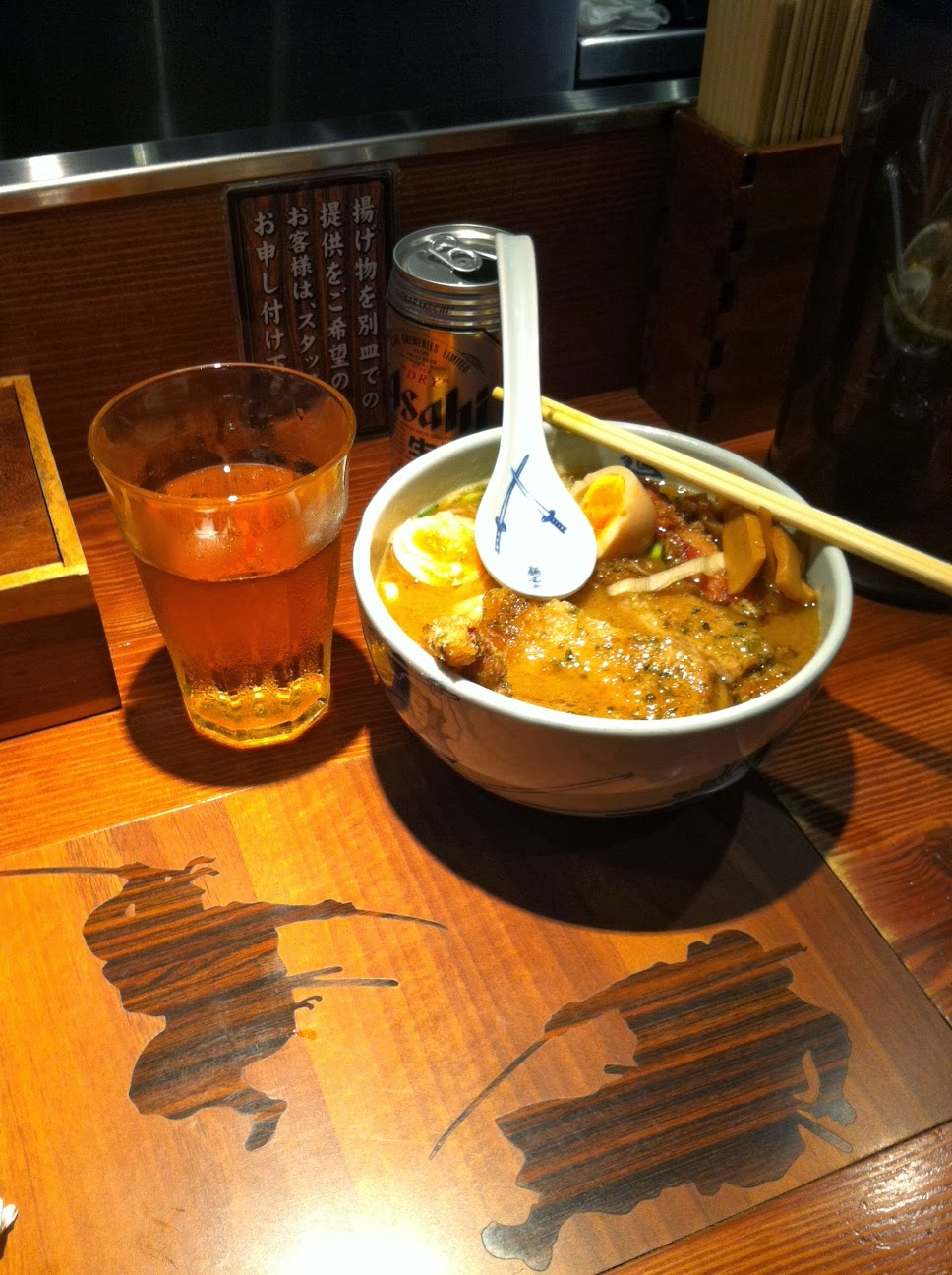
Wednesday, April 04, 2012

A Quote

I was reading Jonathan Frantzen's excellent book "Freedom" and found a great quote that was very applicable to me.


"Looking back now, the autobiographer sees her younger self as one of those
miserable adolescents so angry at her parents that she needed to join a cult
where she could be nicer and friendlier and more generous and subservient than
she could bring herself to be at home anymore. Her cult just happened to
be basketball." (p. 40)


Replace basketball with budo and you have a pretty good picture of me ... at one point, anyway. I like to believe that I have grown up a bit, although I'm not sure that's true.

Tuesday, April 03, 2012

Ed's Visit to Tokyo

Many of my original readers from the Sei Do Kai will know Ed. He visited Tokyo in March to get his 5th-dan in Jodo. He put in some very intensive practice with Tsubaki Sensei on a nearly daily basis for about 2 weeks, along with some visits to Shiiya Sensei's dojo and the Nikkei Dojo, to get pointers and to brush up on his skills before the test.


I tagged along "to help" but of course I was just trying to leech some of the training and pointers, too.

If you know Ed, you will also know that he passed his 5th-dan with flying colours and impressed the pants off of everyone there. Way to go, Ed!

With all that training, there wasn't much time to do anything else, but after the grading he and I did spend an afternoon at the Tokyo Edo Museum...


One of the exhibits was the "face" from the Okamoto Taro "Tower of the Sun" from Expo '70. A quick look at the Wikipedia page mentions that the tower had 3 faces, one of which was in the basement, called "The Face of the Underworld". It is currently in an "unknown location". I wonder if this is it ... or just a facsimile of the main face? Gee, shoulda read the pamphlet.

Playing with the "miniature" effect on my camera.

Wednesday, December 28, 2011

Why I Don't Like University Clubs

Please take most of this post with a grain of salt. It's largely the rantings of a grumpy old man. You've been warned!

Let me begin by saying that I started martial arts at a university club in Canada. But I want to talk now about Japanese university martial arts clubs. I don't think these clubs are a good thing, based on my experience with them.

First, a bit of background. Japanese students go through a long and grueling process to get into university. Most of their time in high school is spent learning very specific knowledge that will prepare them for passing the university entrance examinations. (This is a large part of why most Japanese people can't speak English; they spend all their time memorizing word lists and grammar rules, and almost no time using the language to communicate.) The entrance exams are tough, but once you're in a university, you're in, and it's almost unheard of to flunk out, no matter how little effort you put into your classes. So, most students devote the majority of their time and attention to their club activities. Their club defines who they are, and establishes their social circle. It also prepares them for Japanese corporate life, because in a club (like in any Japanese hierarchy) the new people are scum and do all the work, and the older people (who have put in their time being scum) get to push around the juniors. As my friend put it, Japanese clubs are a "shit totem-pole".

I happen to think that Budo should be something that enriches and gives purpose to your life. What it entails, exactly, is up to the individual, of course, and so Budo might mean many different things to different people. But Budo as it is practiced in Japanese University clubs is, as far as I can tell, just a nasty excuse to get together and for juniors to show their "humility" by kow-towing to the seniors, and for seniors to lord it over the juniors. The best Sensei I have known have been people who, despite their skill, rank, and position, were remarkably humble, courteous, and gracious. This is not what I see being taught in Japanese University clubs.

At the iai dojo I (used to?) attend, about half the students are members of the iaido club from a prestigious Tokyo university. It's not the Harvard or the Yale of Japan ... but it's probably #3. The students there barely acknowledge the presence of anyone who is not in their club ... although of course they are smart enough to bow to the Sensei. It is quite a different story when a 3rd- or 4th-dan "Old Boy" shows up. Then they fall over themselves (sometimes literally) to get down into seiza and put their faces to the floor. They raise a cacophony of meaningless "Osu"-s while the 24- or 25-year-old subject of their affection smiles and waves like a rockstar. I said that they know enough to bow to Sensei, but even a hachidan hanshi does not warrant this degree of adulation from them. (Unless said hachidan hanshi also happened to be an Old Boy - a possibility which, frankly horrifies me...)

When I first started at the Dojo a couple years ago, Sensei introduced me and pointed at all the university students. "They're all studying English, so do them a favour and speak to them in English, would you?" It ended up being a moot point, because I barely ever exchanged words with any of them. My greetings were returned with a blank look or an unenthused, canned response. Certainly none of them was ever anything approaching "friendly".

When a group of Canadian iaidoka came to the dojo for a visit, the university students asked for a photo of them posing with this group of foreigners (whom they hadn't spoken a word to previously) to post on their club website so they could advertise how "international" and cosmopolitan they were. This is what typically passed for "cultural exchange" in Japan, sadly.

My Jodo dojo (Jo-do-jo?) has also recently seen an increase in the number of students who are attending from an associated university club, which is overseen by some of the senior members of our dojo. These students tend to sit in a big circle in the dojo before practice, chatting and giggling with each other. This is in distinct contrast to what I've always been told: the dojo is not a place for idle chit-chat, and time before practice is to be spent warming-up. I've often felt that someone needs to tell them how to behave in the dojo, but I feel it is not my place, and the language barrier holds me back. Plus, there is a nagging feeling that I'm just being a killjoy.

Like the students in my iai dojo, they basically ignore everyone around them (except Sensei, of course). Lest you think I am ticked off because I feel they should be kissing my ass, it is not on my behalf that I am irritated. Our dojo has a number of 7-dan jodoka who have being practicing for 30, 40, or more years. They deserve to be shown respect, and yet they are ignored by these kids who know they should bow to the guy at the front of the room, but otherwise have never bothered to find out who anyone else is.

When practice starts, they are generally made to keep to themselves, which is fine, I suppose, except that I keep seeing someone who has done Jodo for about a year, "teaching" someone who has been doing jodo for about a month. Remember what I said about the shit totem-pole? Well, picture someone who has next to no idea what he is doing, acting like an arrogant know-it-all, teaching incorrect techniques to someone who has absolutely no idea what he is doing, while the junior bows and scrapes to this so-called "senior" the whole time. It takes all my concentration not to intervene. Someone who has done Jodo or Iaido for 1 year should not be teaching anyone anything, much less should they be viewed as something approaching a Sensei, and yet this is what regularly happens in university clubs.

On a few occasions, I have seen someone do something slightly dangerous, that might get them or someone else hurt, and I have intervened and told them what they were doing wrong. This always gets me a confused look (as if to say "Why are you talking to me? You're not in my club!") and a hesitant, somewhat dubious "Oh ... I see ... right ... thankyouverymuch" followed by a quick retreat.

Once, in the iai dojo, a fairly tall student was practicing overhead cuts quite close to a basketball hoop. His "senior" was standing there supervising. I felt as though I should say something as he got closer and closer to hitting the hoop, but kept thinking "It's not my place..." Eventually, of course, the inevitable happened and he hit his sword with force on the metal hoop. Luckily, it didn't snap the tip off his sword or injure anyone. I was left thinking how stupid it was that I didn't say anything, just because of this ridiculous separation between the university students and the non-university members.

Another anecdote. I'm not sure how it fits in really, or what it means, but maybe you can tell me what you think.

It was September and we were just starting second semester at the university where I teach. I ran into one of my first-semester students, named Mariko. I asked her how her summer vacation had been. "Oh, so-so" she told me. Really? I asked. Why only so-so?
"I spent every day, only doing club."
"What club do you belong to?"
"Kyudo club."
"Oh really?" I said. I told her that I had done a very little bit of Kyudo in the past, and that I found it to be a beautiful and interesting art.
She looked a bit skeptical. I asked her "How many days a week did you practice Kyudo?"
"Every day. Seven days a week." Wow, so she was being literal!
"Oh, well, how long did you practice Kyudo every day?"
She counted on her fingers for a second. "Mm... six or seven hours. Verrrrry tired!" she said with a grimace.
"Really? You practiced six or seven hours!?"
"Well, not practice all time. Sometimes practice, and cleaning dojo, and talking with seniors..."
I was reminded of something Haruna Sensei always used to say. I repeated it to her:
"It is better to do something once, while thinking about it, than to do something one hundred times without thinking." And then I added my own, overly-blunt thoughts: "You can't concentrate on anything for 6 or 7 hours. You should do 2 hours a day and then go home, or go study, get a job, enjoy your life. 6 or 7 hours is way too long to spend doing Kyudo every day!"
She smiled in that way Japanese people do when they feel uncomfortable. "Mmm. Very deep idea. Maybe."

The thing is that Mariko probably didn't have a choice how much time she practiced. With Japanese clubs, you are fully in, or you're out. If you don't do what your seniors tell you to do, you're criticized and eventually ostracized until you quit. And that's your social circle and group identity, gone.

There's something sick at work in the university clubs here. Budo here might be partly about overcoming obstacles, building self-discipline and self-development, but I get the feeling that it's largely about torture, too. Another friend told me about a kendo summer gasshuku where juniors were forced to run around in a circle while seniors beat their ankles with shinai. What in god's name does that have to do with kendo? What does sitting around in 40-degree heat for 7 hours a day, cleaning the dojo or mowing the archery range grass or collecting arrows or fetching drinks for your seniors have to do with Kyudo?

The most important things for seniors and sensei to learn are compassion, generosity, encouragement, understanding, and courtesy. You learn this as a junior, from your seniors, who should be good role-models. I don't see much of that in university clubs, unfortunately.

Monday, November 21, 2011

Damnit...

Just a quick post for now. 2 weeks ago, I had a week off work so I took a few days and went down to Kyushu. I was able to re-connect with some of my old Sensei from down there, and I took almost 700 photos. Some of those will end up on here at some stage. Being down there was great, but kind of bittersweet, because it made me remember how much nicer Kyushu people are than Tokyo people. (This is just a generalization, of course!)

Last week, it finally started getting quite cool and the dojo was actually a nice temperature for Jodo practice. For the first time since early spring, my feet weren't sweating and I could actually move around properly. It was awesome!

The unexpected outcome, though, was that I woke up with terrible pain in my ankle and on the top of my foot. I could barely walk, but managed to hobble slowly to the train. I tried to stay seated as much as possible while teaching, but by the end of the day, my foot was quite swollen.

I couldn't figure out what had happened to me! Obviously, my feet finally having a bit of traction meant that I was able to put a much greater load through my ankle. I didn't feel anything at the time, but I must have strained the tendons in my foot and ankle. I thought it might be tendonitis - why else would I not have felt anything until the next morning? - but there was quite a bit of bruising on the top of my foot, suggesting something was torn somewhere.

Japanese medicine, I've found, leaves a lot to be desired. The doctor looked at my foot and said, "It's quite swollen. Looks really painful." Yes, I asked, but what actually happened? [Doctor cocks head to one side:] "I know, right? What happened, indeed..." Her advice was to try and stay off of it for a while, to ice it, elevate it, and if it still hurts on Monday, to go get x-rays just in case. Oh, and the advice I always get from doctors: try to lose some weight.

Today is Monday and it feels a lot better, so I don't think I need an x-ray. But I'm still wondering what it could have been. No pain the night of practice; agonizing pain the next morning, which got worse after walking and standing on it all day (duh); considerable swelling; some bruising on the upper surface of the foot and around the toes. Any amateur (or professional!) diagnoses? Advice? Similar experiences?

The main point I'm taking away from all of this is: don't neglect cross-training. I've gotten so out of shape these past few months because one or two nights of Jodo a week is just about the only thing I do. It's not good to do nothing all the time, and then suddenly move around vigorously ... (double duh).

Monday, October 24, 2011

Jodo Grading

I passed my Jodo 5th dan on Saturday. The gradings are held at the Tokyo Budokan, which is a wonderful place to do Budo because of its excellent, unvarnished, sprung hardwood flooring. Even with my sweaty feet, the moisture is absorbed almost immediately by the unfinished wood, creating a surface that is neither sticky (when your feet are only a little moist) nor slippery (which happens when your feet are really wet). As my sweaty feet are caused partially by nerves, and exacerbated by slipping and sliding (see if you don't get nervous doing iaido or jodo on a floor that has just been wet-mopped!) this calmed me down a lot and in turn, led to less sweating, I think. In any case, the footing was excellent.

The grading was originally scheduled for mid-March, but was cancelled due to the Tohoku earthquake and tsunami. It has been weird weather lately in Tokyo. It has been noticeably much cooler, like 21 - 24 degrees, but the humidity has stayed quite high so that it feels cool, but if you move around, you immediately start to sweat. Your body doesn't quite know what's going on. I wore a jacket but by the time I got to the Budokan, I was drenched with sweat and feeling very uncomfortable.

I was running a bit late because I had washed my keikogi in anticipation of the grading, but with all the humidity, it hadn't dried in 2 days! So I had had to take it to a coin laundry and give it a quick spin in the dryer. This put me behind schedule and meant I had to rush to get there on time, and I think my partner, John, was getting a bit nervous. He seemed relieved when I finally arrived. I quickly changed into my keikogi, and we had time to go through the techniques once before the organizers called us to line up.

There were 25 candidates for 4th dan, and 24 candidates for 5th. We all had to sit on the floor in rows and wait for our turn to grade, which was done 4 people at a time (2 groups of 2). In a jodo grading, you perform one side, then do shi-uchi kotai, and perform the other side. You are graded on both your jo techniques and your tachi, so the judges are quite busy watching both sides, which is why about 4 people is the practical limit. It does make for a slow grading, though. In the end, we had to wait for about an hour before it was our turn to go on - an hour of getting increasingly nervous, and getting sore and stiff sitting on the floor.

I was exceedingly nervous waiting for my turn, but when I got out on the floor, everything seemed to go very quiet and I felt really calm. For 5th dan, you must do techniques 8-12. By the time I got through the jo side and did Ran-Ai, my adrenaline was coursing and I was trembling. We did shi-uchi kotai and I forced myself to calm down. As we got into the techniques, I re-entered a zone of mental focus. But by the time we got to Ran-Ai, I was hyperventilating again. Quite a rollercoaster ride.

We were almost the last group to test, which meant we didn't have to wait very long to see the results posted. Our numbers were written on the wall - we had passed! (The practical component, at least!) The judges were evidently quite strict because the pass rate was less than 50%. Now it was time for the written exam.

We had to answer 3 questions about Jodo and write our answers in Japanese. This was done in advance, and then submitted on the test day. I had written mine first in English, and then taken it to about 4 Japanese friends, all of whom gave me slightly different corrections! Settling on an averaged version, I wrote out my answer, which only took me about an hour (including 2 false starts where I made a mistake and had to start over!) Again, you sit on the floor in front of the judges' table as they go through the papers one by one. If there was any question about the contents, candidates were called up in front of the judge reading their paper. It wasn't long before my name was called.

I ran up to the table. "Did you write this yourself?" asked the judge. "Yes," I said. "Hmph. You wrote here that in the seated bow, it is left hand, right hand. That's the way we used to do it. Now it is both hands at the same time. Please remember that." "Yes Sensei, I will." Shiiya Sensei looked at me from the next seat over and laughed. "What's the matter with you? Who the heck taught YOU?" I just bowed and tried to look chastened. I returned to my spot and even from where I was sitting, I saw the judge writing on my paper: stroke, stroke, stroke, small square, all enclosed by a big circle - the kanji for "Pass"! Yay!

Despite a few mistakes here and there (which were all clarified in quick conferences with the judges) everyone who passed the practical exam also passed the written exam. We stood up and Shiiya Sensei gave us a quick speech. "Congratulations on passing, and you have all worked very hard. But the real work starts now. You are going to be asked to teach more and more from now on. You need to make sure your techniques are correct and that you know what you are supposed to do. For example, with the etiquette in the Zen Ken Ren. [Looking at me] If you're teaching, you'd better get it right. But anyway, congratulations to you all!"

After that, there was a lot of bowing, thanking, handshaking, and so on. We celebrated with a few quick beers, and I felt absolutely GREAT. At the same time, I knew that if I had failed, I would have been crushed. It's not good to get so emotionally invested in gradings. You have to keep an even keel and just keep heading forward, regardless of whether things go well or go badly. I knew I probably shouldn't feel so good, but I couldn't help it.

As I've probably mentioned, I haven't been doing much iai lately. I have been able to kind of "blame" that on having to focus on Jodo in advance of my grading, but I don't have that excuse any more. At dinner, I was seated next to Tsubaki Sensei, who does both Iaido and Jodo. He asked me about Iai, and we had a good talk where he basically told me to get my ass back to Iaido and just do standing techniques. So I'm going to try and channel some of this positive momentum from Jodo into Iaido ... keep moving forward, keep moving forward ... Kind of like a shark. Stop moving, and you die.

Tuesday, September 27, 2011

Thoughts on Viewing Martial Arts

I've been to a few events with a large number of very, very talented martial artists demonstrating. For example, I've been to the All-Japan Iaido tournament a few times, the All-Japan Kendo championships half a dozen times maybe, as well as the All-Japan Jodo tournament twice. I've been to a few kobudo demonstrations with hundreds of representatives of various koryu bujutsu groups performing over the course of a full day.

These events are definitely not the best place to view martial arts. The performers are unquestionably top-notch. The problem is that you get numb to what you're seeing. I've never been to the Louvre Museum, or the Prado, or the Rijksmueum, but I've heard that the sheer number of masterpieces on display eventually makes you breeze past paintings in a second or two that, were they displayed on their own, you might otherwise spend hours trying to take in.

I was having these kinds of thoughts last year, after going to the All-Japan Iaido tournament followed by an extensive koryu bujutsu demonstration in the same month. A few weeks later, I went to a public exhibition of a large national calligraphy contest.

Viewed singly, the works of art were breathtaking. A single, powerful word written by a shodo master could be analogous to a single iaido kata performed by a hachidan hanshi.


A series of kanji, part of a single, unified work of art and written by one hand, might be analogous to a demonstration of a set of kata from the same school, performed by a master of that school. The characteristic flavour of the school, as well as the individual performing it, comes across clearly and leaves a strong impression on the viewer.


Seeing a number of works of art at the same time, it is evident that they are slightly different, but it begins to become difficult to appreciate how they are different, or which is better, and why.


After viewing more and more demonstrations, you begin to feel a bit overwhelmed by it all. One performer ... or one work ... is starting to blur into the next.


You might even start to lose interest - even if you are deeply fascinated by your own study of martial arts (or calligraphy, or painting, or photography...)


And so it got me thinking about focusing on one work ... or focusing on an expert performance of a single kata. You begin to evaluate things on a more technical level. How did he or she make this movement? How did this sense of pressure or power occur at this instant? Why is the sword stopping here, and not there?

As you look closer, details begin to emerge.


Looking even closer, more details emerge. The almost "fractal" nature of the kata - the sense that there is no end to the level to which you can analyze the parts - becomes almost overwhelming.


Looking too closely, you lose your perspective and the work starts to lose the overall meaning it had before.


Step back and look from a position where you can see the whole, as well as the details, and you may be struck again by the beauty of this one-time event - captured on paper, on video, or in your memory.

Friday, September 16, 2011

Jodo Slip'n'Slide

It was very hot at practice last night and, because I am not only a natural sweater (in general) but have particularly sweaty hands and feet, it was tough. Just moving around on the floor without slipping was hard. If I tried to move powerfully forward, my back foot would slip out on me, so I was forced to take tiny little steps. Sensei kept telling me, "Bigger! Step in powerfully!" and I kept mumbling about having sweaty feet. I could tell that he wasn't getting it. If you have dry to normal feet, then it is hard to understand, I suppose.

The other thing that was happening is that I could barely hold onto my jo. Obviously, this makes a lot of things really difficult. For example, dō-barai (a defensive movement where you swing the jo sideways to block a disemboweling stroke) is hard to do quickly. Because I knew I was going to be slow with it, I was beginning the movement too soon. Sensei kept telling me, "You're blocking before the strike has even started! That makes no sense! You've got to wait..." so I'd wait, and then I wouldn't be able to get the jo over to block in time. "You're too slow! You're letting him cut you! Faster!" I just couldn't win.

Having a wet jo and sweaty hands did have one unexpected benefit, though. Sensei is always talking about how you can only really put power in the jo when you slide your hands. The ability to slide your hands is the jo side's "secret weapon". Well, my hands were certainly very, very slippy-slidy last night. It was almost all I could do NOT to bash the tachi out of my partner's hands when I did hikiotoshi. As long as my angle was good, the jo went through the tachi as if it wasn't even there and my partner's tachi went into the floor, or into his foot, or behind him, wherever I wanted it to go. It was kind of fun ... except that I almost lost my grip on my jo every time.

What does this mean for all of you with normal sweat levels? You might want to try a few hikiotoshi strikes using a single glove or mitten. Choose one made of cotton, wool, or fleece that will enable your hand to slide easily on a dry jo. Then carefully (!) do some hikiotoshi strikes and see if the increased slide helps you put power into your strike. I would say don't deliberately try to put a lot of power into your strike, but just see what happens when your hand slides easily down the jo. Be careful because if your glove is very slippery, you may not have enough friction to easily apply the "brakes" at the end of the strike. Then take off the glove and see if you are able to relax your grip enough to allow a good slide. If anybody tries this, I'd like to hear how it worked out.